%20scale(0.62)'%20d='M12%201.8C12.7%207.2%2016.8%2011.3%2022.2%2012%2016.8%2012.7%2012.7%2016.8%2012%2022.2%2011.3%2016.8%207.2%2012.7%201.8%2012%207.2%2011.3%2011.3%207.2%2012%201.8Z'/%3e%3c/svg%3e)
%20scale(0.62)'%20d='M12%201.8C12.7%207.2%2016.8%2011.3%2022.2%2012%2016.8%2012.7%2012.7%2016.8%2012%2022.2%2011.3%2016.8%207.2%2012.7%201.8%2012%207.2%2011.3%2011.3%207.2%2012%201.8Z'/%3e%3c/svg%3e)
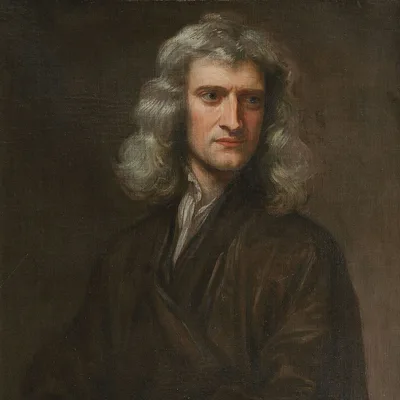
Isaac Newton · 科学家
Experience
Held the Lucasian Chair from age 26. Published the Principia Mathematica (1687) — the three laws of motion and universal gravitation, founding classical mechanics and widely regarded as one of the most important works in the history of science.
In optics, performed the prism experiments, proposed his theory of colour and built the reflecting telescope; published Opticks (1704). In mathematics, developed the calculus (fluxions) and the binomial theorem.
Served as Warden and then Master of the Mint; oversaw the Great Recoinage, moved the currency toward a gold standard, tightened coin quality, and aggressively investigated and prosecuted counterfeiters (such as the notorious William Chaloner).
President of the Royal Society for over two decades, shaping the direction and standards of experimental science and cementing Britain’s place in the Scientific Revolution.
Elected twice as MP for the University of Cambridge, serving in Parliament after the Glorious Revolution.
Selected Work
The three laws of motion and universal gravitation — founding classical mechanics; one of the most important works in the history of science.
A systematic treatment of light and colour, proving white light is a mixture of colours.
Created independently of Leibniz; the foundational tool of modern mathematics and physics.
Replaced lenses with mirrors to eliminate chromatic aberration — a main line of modern telescopes.
Unified orbits, tides and projectile motion, founding celestial mechanics.
Education
Took his B.A. in 1665; during the plague-year retreat that followed — his “year of wonders” — he made his breakthroughs in calculus, gravitation and optics.
示例数据,仅供参考